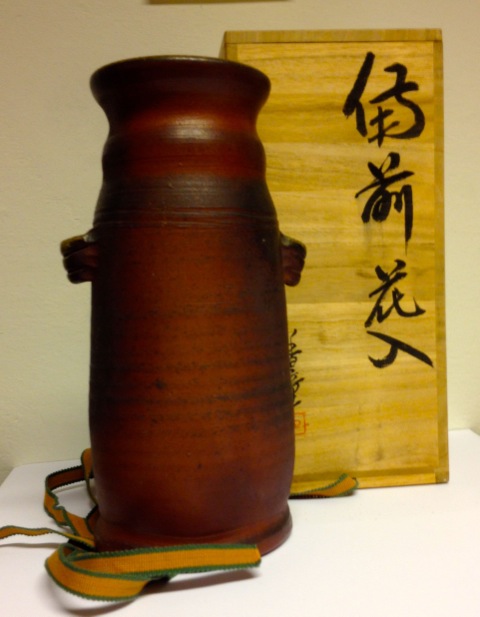
Tall cylinder hand thrown vase with two small protrusions, one on each side. The vase has a brown, beige and red color and is made in the Bizen ware technique (see Notes). The box measures 15,2×15,2×32,5 and had orange and green ribbon ties to close it.
| ID Oggetto | 619 |
| Tipologia | Gifts |
| Paese | Japan |
| Materiale | Ceramic; wood |
| Dimensioni | L 12 (diameter) cm × H 27,5 cm |
| Iscrizioni | There is Japanese writing and the stamp of the artist on the side of the wooden box. The signature of the artist (OO) is incised on the bottom of the vase. |
| Collocazione | 4a |
| Luogo | Palazzo Coppini, Firenze |
Note
Bizen ware (備前焼 Bizen-yaki?) is a type of Japanese pottery most identifiable by its ironlike hardness, reddish brown color, absence of glaze (though there can be traces of molten ash looking like glaze), and markings resulting from wood-burning kiln firing.
Bizen is named after the village of Imbe in Okayama prefecture, formerly known as Bizen province. This artwork is Japans oldest pottery making technique, introduced in the Heian period. Bizen is one of the six remaining kilns of medieval Japan.
Bizen clay bodies have a high iron content and, traditionally, much organic matter that is unreceptive to glazing. The clay can take many forms.